


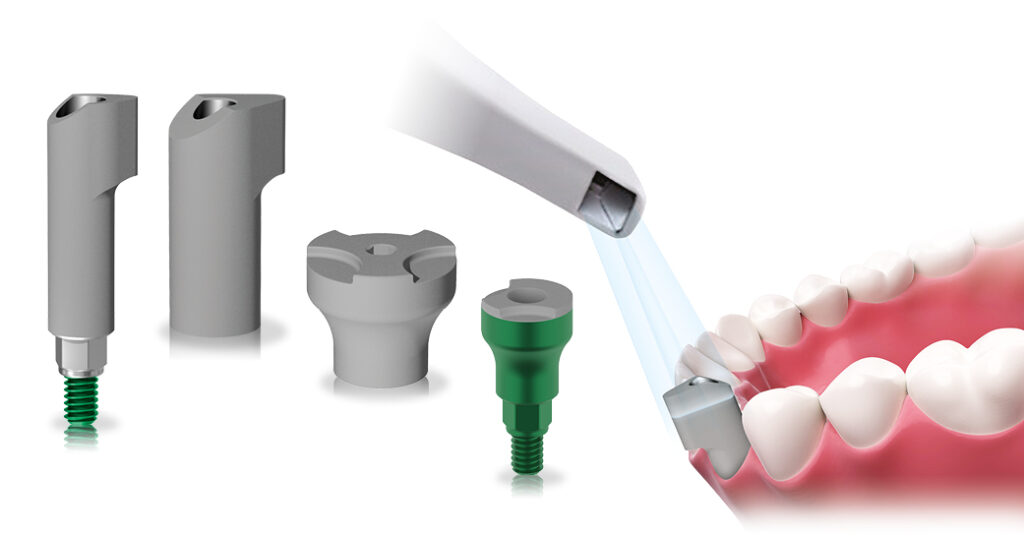
Scan bodies and intraoral scanners: what they are and how they work
Scan bodies and intraoral scanners are now the future of prosthetic rehabilitations on implants; all that’s left is to discover what they are and how they work.
Traditional impression techniques for building the prosthesis on implants required the use of a particular paste that created various problems and discomfort. Patients could not stand its taste (unpleasant for many), and for many it triggered a strong gag reflex. Finally, the dentist sometimes had difficulty inserting the paste and the impression tray in patients with a small mouth opening. Today there are valid alternatives to the analogue impression: thanks to digitalization, all these issues are now just a distant memory.
Implantology has evolved, and so have the tools that support it. First among them is the intraoral scanner, which allows a complete digital scan of the teeth and gums to be carried out in a few seconds with extremely high precision, simply by passing the tip of the device near the surfaces to be scanned.
To then obtain the position of the implant inside the mouth, it is necessary to use scan bodies, that is, scanning abutments through which it is possible to detect their position using the intraoral scanner. The scan body is used as a positional reference, making it possible to use the T-base, which will act as an abutment to recreate the patient’s tooth from scratch.
Features of the JD Scanbody:
- Available for all JDentalCare implant lines
- Made of Grade 5 Titanium
- The asymmetric shape makes it easy to identify the implant’s unique position
- The surface treatment makes scanning easier
- Limited vertical dimensions for easy, fast positioning even in hard-to-reach areas
- The straight shape of the body reduces soft tissue compression
For more information, visit the page dedicated to JD Digital Solutions.
The advantages:
Digitizing the impression process makes it possible to significantly simplify the workflow and increase patient comfort, taking an optical impression simply and accurately. Treatment time is drastically reduced, the precision of the prosthetic restoration is increased by eliminating the margins of error of the analogue process, and once the teeth have been placed in the mouth, a digital copy of the work remains, allowing teeth identical to the originals to be reproduced indefinitely in case of future wear.
Want to take a closer look at the advantages of digital implantology and learn to apply these techniques? Contact us for more information or discover all the digital implantology courses at the JDentalCare Training Center and find the one best suited to your level of experience.